
 Beat up, painful shoulders are a common occurrence in many a lifter’s life, but it doesn’t need to be this way. With a simple screen and a few exercises during the time you would usually use for rest, you may be able to prevent many of these common shoulder aches and pains.
The Functional Movement Screen
The Functional Movement Screen (FMS) is a series of seven tests, which at the most basic level are used to screen for pain with the fundamental human movements. On a deeper level, they may actually tell us so much more. For instance, the seven tests actually relate to developmental kinesiology- how babies naturally explore movement and learn to roll, crawl, stand and walk. The seven tests may also help us to alter the categories of movement and specific exercises we would typically program by pointing out where we should use, as Charlie Weingroff states, regressions and lateralizations (more on those later):
Screen Name |
Category of Movement it Relates To |
1.) Deep Squat |
– Squat and related exercises |
2.) Hurdle Step |
– Single Leg Stance and related exercises |
3.) In-Line Lunge |
– Lunge and related exercises |
4.) Shoulder Mobility |
– Push/Sometimes Pull and related exercises– Consider results of Trunk Stability Push-Up as well… |
5.) Active Straight Leg Raise |
– Hinge and related exercises |
6.) Trunk Stability Push-Up |
– Core Stability, Upper Body Horizontal Push and related exercises |
7.) Rotary Stability |
– Rotation (resistance or movement), Rolling and related exercises |
While I don’t intend to teach the intricate details of the FMS in this post, I would like for you to understand a few basic concepts and how the shoulder mobility and trunk stability push-up tests are scored.
Every test is scored with a numerical value of 0 (pain- must be evaluated and treated by a medical professional), 1 (outside of acceptable standards or cannot complete test), 2 (within acceptable standards, minimal compensation), or 3 (great). Tests that take left and right side into consideration are given the mark of the lesser scored side if there is an asymmetry. If there is a pain clearance test (shoulder mobility, trunk stability push-up, and rotary stability), it is scored as + or – for pain. If the test turns up + for pain, the related test’s score automatically turns to a 0.
I use the above scores to identify red light patterns, a term popularized by Brett Jones. Asymmetries and 1’s = red light patterns. Think of red light patterns as those which will have a directly negative impact on the movement patterns/categories that the test relates to, as listed above. This information, combined with some thought, helps with exercise selection, regressions, and lateralizations…
By the standards of the FMS algorithm, all things being equal, we are to work on mobility first (shoulder mobility/active straight leg raise), stability second (trunk stability push-up/rotary stability), and then a somewhat specific order of movements to hurdle step, in-line lunge, and finally the deep squat.
Shoulder Mobility
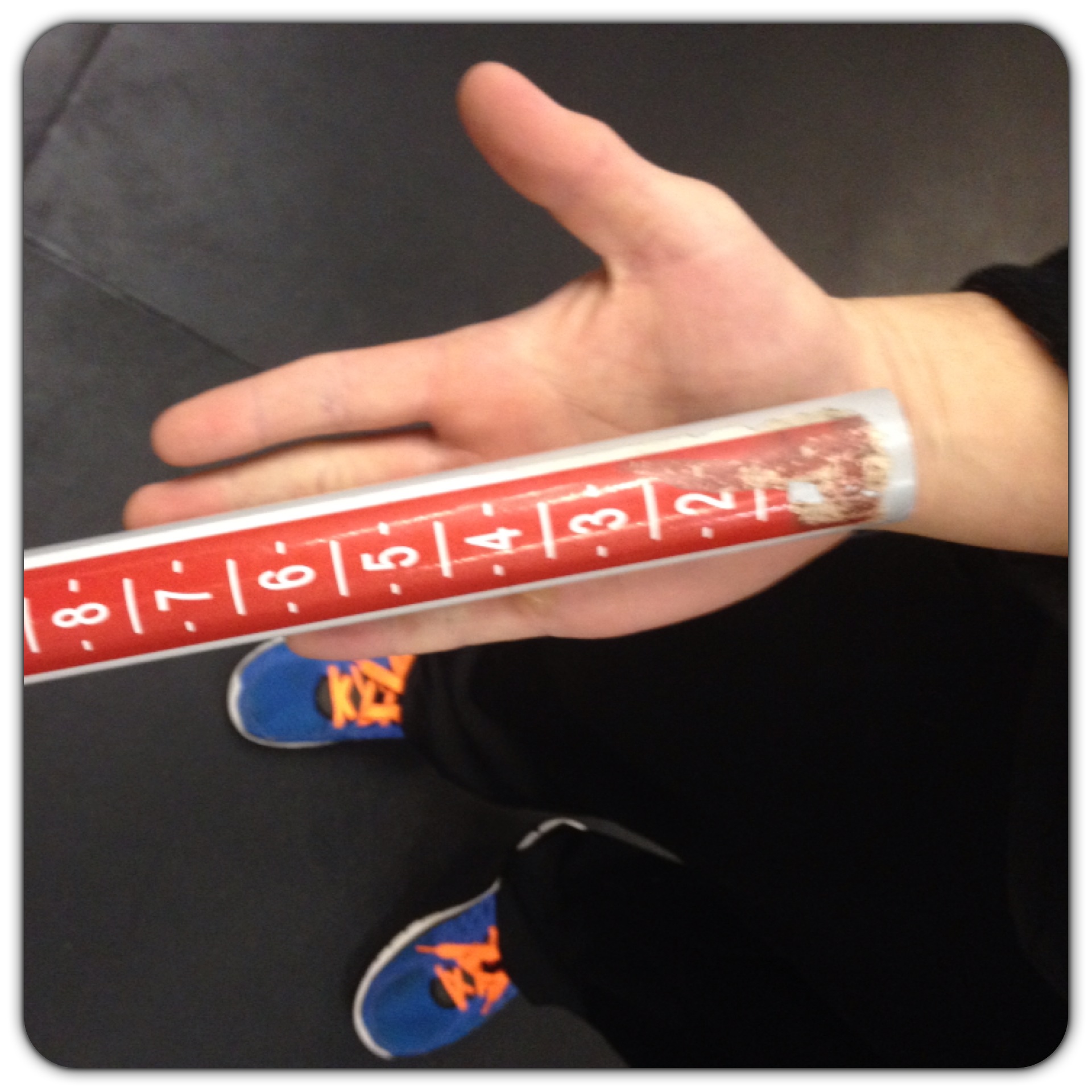
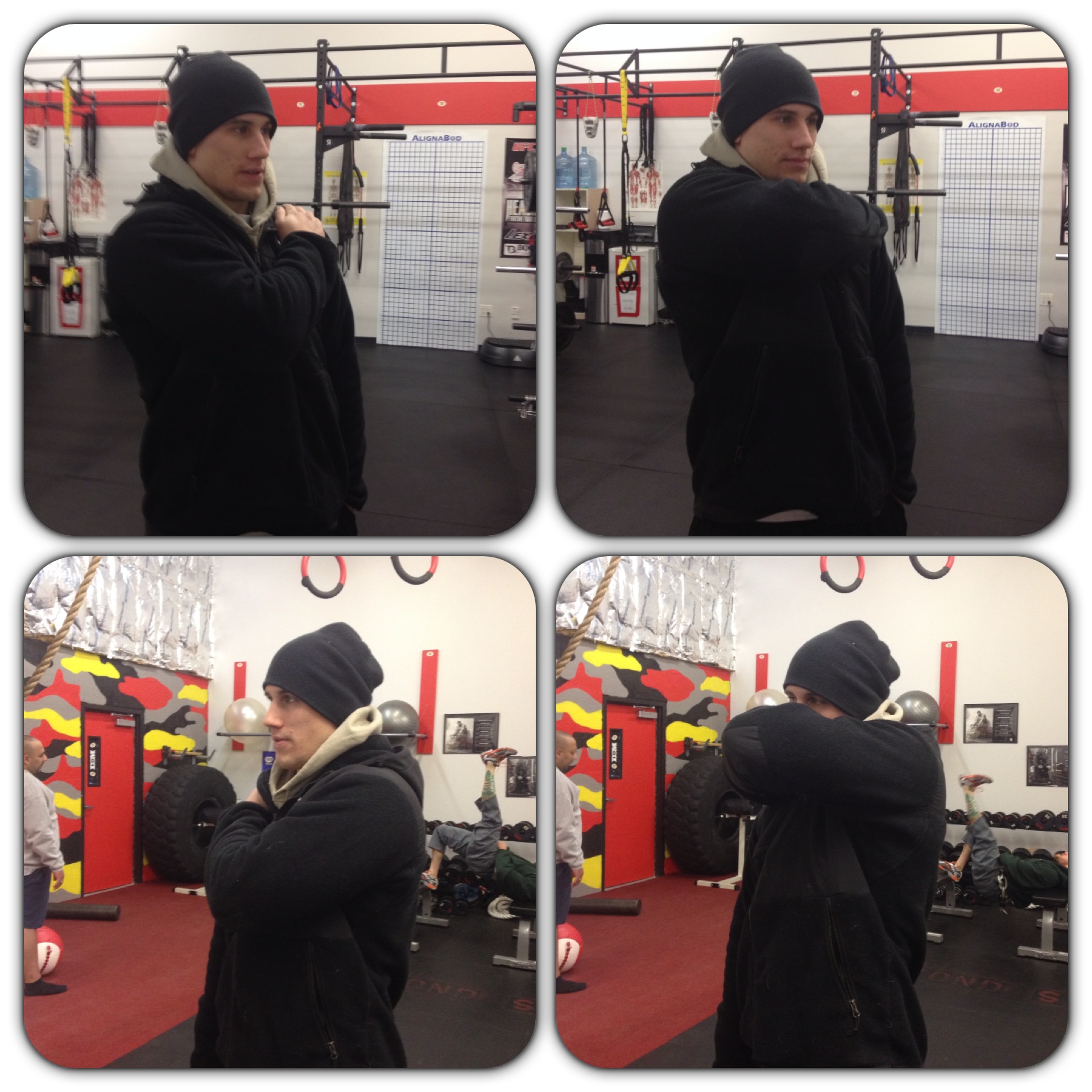
1.) Measure hand length as the baseline:
2.) Set-up and test:
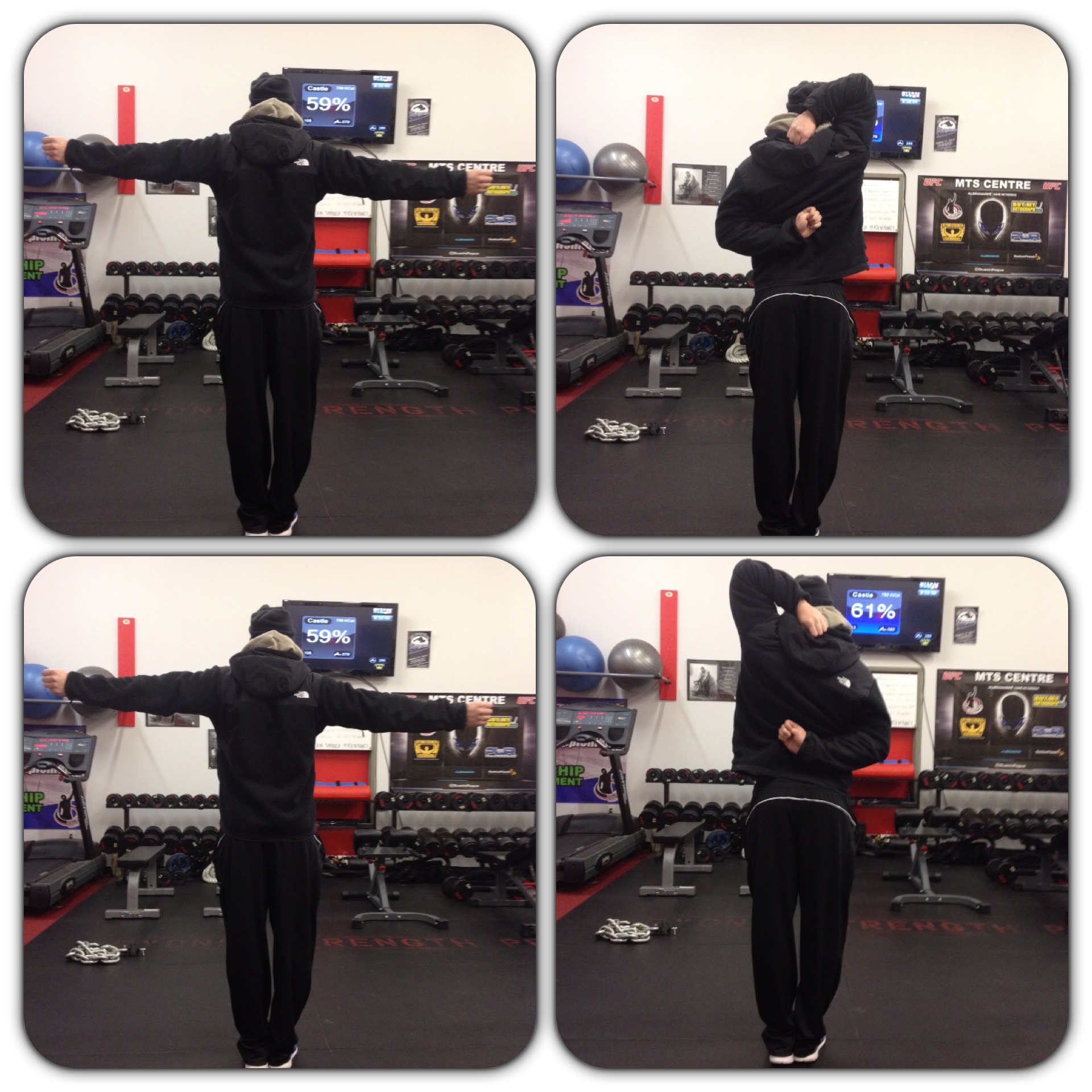
3.) Measure distance between hands (less than hand length between hands = 3; up to a hand length and a half = 2; further than hand length and a half = 1)
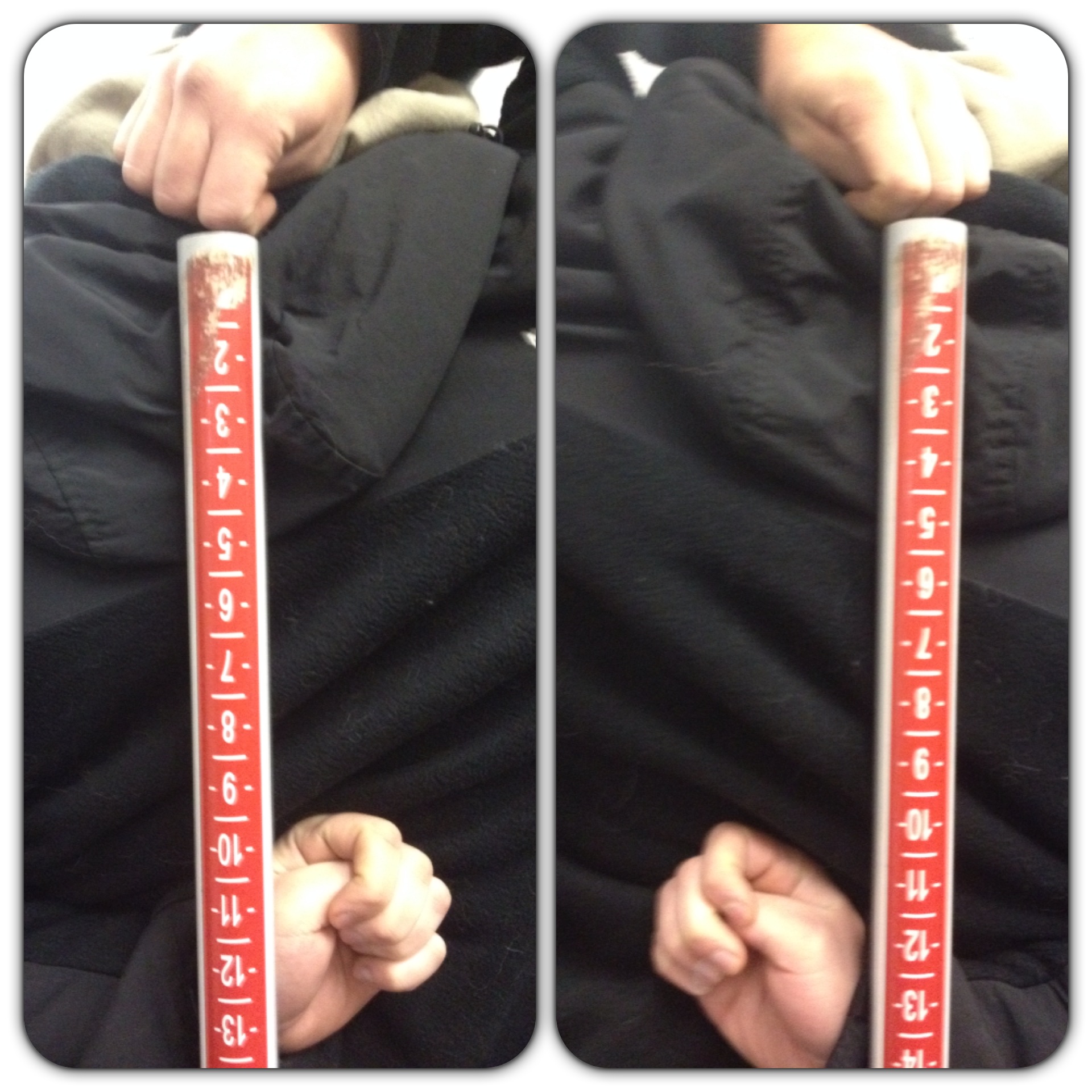
4.) Check for pain. If pain is present, score becomes a zero (I apologize, these pictures should not have been done with Zach wearing a jacket)
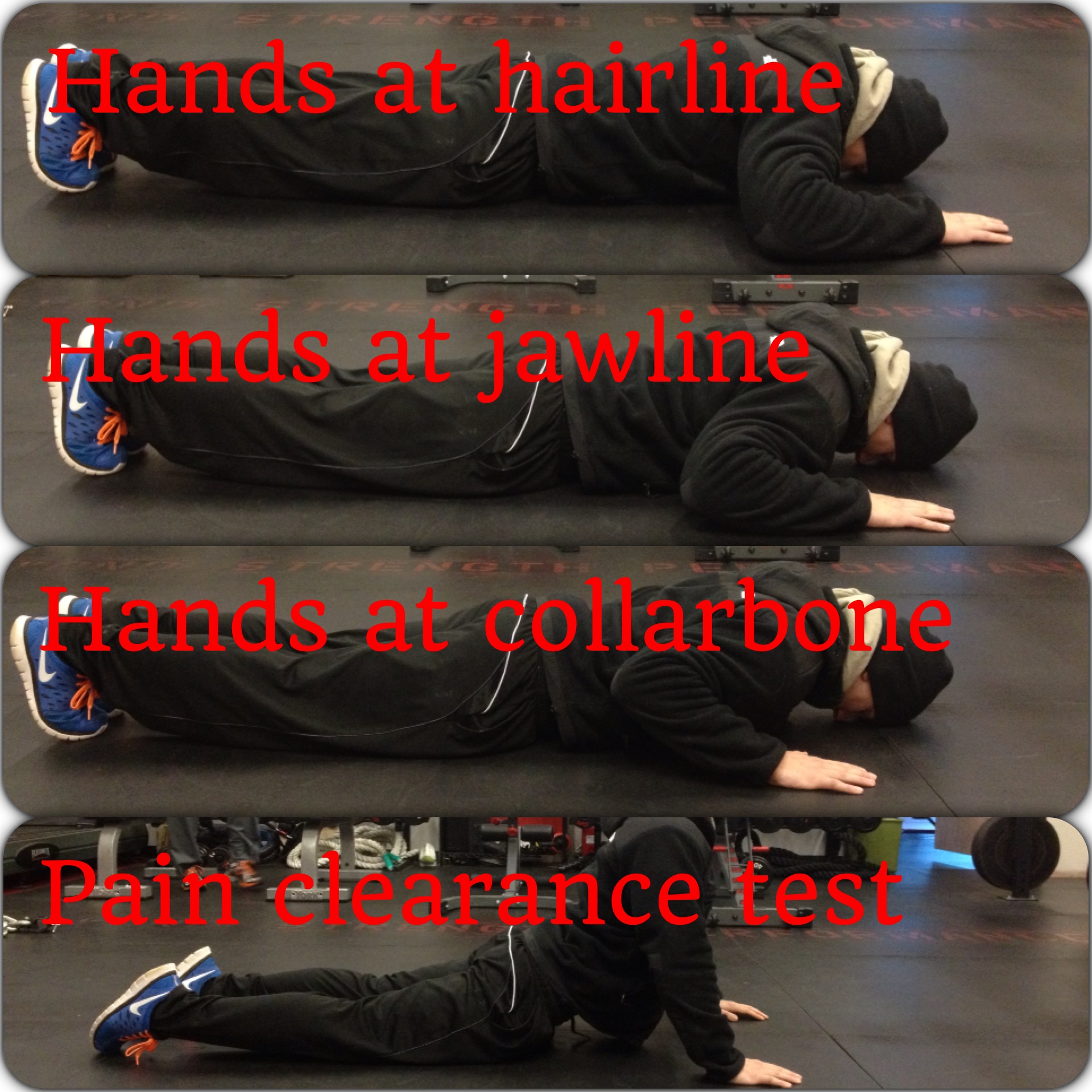
Trunk Stability Push-Up
1.) Set-up and test. The below start positions are the beginning positions for a 3 for a male (hairline); a 2 for a male or 3 for a female (jawline); and a 2 for a female (collarbone) on the trunk stability push-up. The subject would have to be able to press up, all as one unit (legs, midsection, shoulders and head all rise at once), into the top position of a push-up from the start position. If the subject could not complete a push-up from the position for a score of 2, they would receive a 1 on the test.
Let’s imagine that our subject was a 2 on the left shoulder, a 3 on the right shoulder, and at least symmetrical 2’s on the remainder of the tests. We will want to avoid training the related patterns/movement categories to the shoulder mobility, especially with full range of motion and/or load, until they become at least symmetrical 2’s.
Exercise Selection, Regressions, and Lateralizations
Because shoulder mobility is of concern (asymmetrical), we will want to address this in our subject’s programming.
Exercise Selection
As mentioned in the chart at the beginning of this post, the shoulder mobility test relates to pushing, sometimes pulling, their related exercises, and should also consider the results of the trunk stability push-up. Why trunk stability push-up? It’s a closed kinetic chain horizontal push! If the trunk stability push-up is a pain-free 2 or 3, I’m fairly confident to potentially progress horizontal closed kinetic chain pushing patterns in the programming, while addressing the mobility, static motor control, and dynamic motor control of the shoulders (glenohumeral and thoracic).
I will also more than likely remove full range of motion vertical pressing (closed and open chain), open chain horizontal pressing, and MAYBE vertical pulling (if the subjects overhead mobility is lacking and causes a compensated, protracted shoulder position during the pull).
Wow! Doesn’t leave much, right?
Not so fast… we can still push our other patterns with appropriate amounts of volume and intensity, and that leaves A LOT of options to provide an appropriately intense program.
Regressions
While we are not going to necessarily “train” the aforementioned patterns with load and intensity over full ranges of motion, we are going to use regressions to address the issues at hand. We have a number of options here*:
Soft Tissue Mobilization: This would be various forms of manual therapy. We may also use foam rolling/lacrosse ball work here, but I won’t claim to be working on the fascia with these techniques, rather a quick analgesic effect to allow some work to be done on that day (this is not the most ideal route).
Dry needling and Dr. Andreo Spina’s Functional Anatomic Palpation Systems (F.A.P.) and Functional Range Release (F.R.R.) are the best actual myofascial release treatments that I am aware of. I have also experienced positive reactions to FAKTR (pronounced FACTOR) with Dr. Matt Clay of Recharge Sports Injury Center. It’s one of those things where I really couldn’t explain WHY it works, but it helped to alleviate shoulder pain that I’ve had for months after just two sessions, and it has stuck.
Assisted or Passive Mobility/Self-Mobility Training: I’m hesitant to use the term mobility here, because while well-intentioned professionals have been using these techniques for a long time (with great results), assisted and passive flexibility is probably a better term for some of the techniques we see commonly see being used. On the other hand, once again, Dr. Andreo Spina’s Functional Range Release for the true assisted mobility portions, and his Functional Range Conditioning (F.R.C.), specifically PAILS (progressive angular isometric loading) and RAILS (regressive angular isometric loading) is a great system for tackling true mobility issues.
However, I have had great success with the traditional FMS “correctives” as well (rib grab t-spine rotation, t-spine rotation with reach, wall sit with reach, etc…).
Activation/Patterning/Reactive Neuromuscular Training: There are a lot of options that could fall into these categories. Reactive neuromuscular training (RNT) may feed the mistake, making someone feel it pulling them the “wrong way” in an exaggerated fashion so they naturally react to correct the problem. RNT may also use rhythmic stabilization, which is basically micro disturbances to their positioning at random angles and intervals. Specifically for the shoulder, it trains rotator cuff timing and control in varying positions of instability.
For patterning I am a huge fan of eccentric neural grooving, presented to me, once again, by Dr. Andreo Spina. The eccentric phase is great for teaching us patterning, even when it it sometimes differs slightly from the concentric path of the movement. This eccentric first focus was also a big theme in my post two weeks ago about Triphasic Training (read that here: www.beyondstrengthperformance.com/applying-the-basic-concept-of-triphasic-training).
Activation is commonly screwed up by many a coach, and even therapist, confusing the relationship of phasic and tonic muscles (role of the glute medius, rotator cuff, serratus anterior, etc…). My go-to “activation” drills, if you even want to call them that, are isometrics. Time under tension with proper form is a hell of a movement drug.
Static Motor Control (Stability): Common FMS examples for the shoulder include trunk stability rotation, shoulder packing drills, and deadlift variations. I also like to use passive range holds and lift-offs, from Functional Range Conditioning, as fillers for static motor control.
Dynamic Motor Control (Stability): Common FMS examples for the shoulder include kettlebell arm bar (one of my favorites), 1/2 Turkish get-ups, push-ups, swings, and bottoms-up carries. Functional Range Conditioning’s end-range rotational training works great as well.
Resisted Exercise: Resisted exercise is used to “concrete” the newly mobile pattern with load. For the shoulder, we commonly use bottoms-up single arm pressing variations and regular/alternating single arm pressing variations.
One of my favorite ways to work on these issues is with the use of fillers instead of typical rest. As I said above, we can still push all of the other patterns that were at least symmetrical 2’s. To do this, I commonly use tri-sets. The third exercise would be a mobility drill in the first tri-set, a static motor control drill or rhythmic stabilization in the second tri-set, and a dynamic motor control drill or activation/patterning in the third tri-set.
*The above category names are taken from Charlie Weingroff’s Staff In Service at MBSC (March of 2013) – bodybyboyleonline.com
Lateralizations
Lateralizations are an awesome concept that I also heard about from Charlie Weingroff. They are basically a way to side-step the mobility issues at hand, and train them in small ranges of motion with load. For instance, going with the shoulder example we’ve been using, we could use rack bench press (maybe 1/2 of our usual range of motion), board bench press, overhead rack press lockouts (if overhead positioning is okay), etc…
The goal with lateralizations is to do no harm, while allowing the client to get some weight in their hands. We are not necessarily improving the pattern with these exercises, but we are also not detracting from regressed work above either- not to mention the mental edge of having them still able to feel weight in their hands.
Conclusion
As I said in my opening statement, beat up, painful shoulders are a common occurrence in many a lifter’s life, but it doesn’t need to be this way. With the information that I just presented I hope that you will all look to go to through the Functional Movement Screen, find out your weak links and asymmetries, and work with a strength coach/therapist that understands your unique needs.
This is not an ongoing process that should take months! Or goal here at BSP NOVA is to see symmetrical 2’s or better across the board within the first few weeks of beginning training.
Injuries are bound to happen, but let’s do our part to make acute aches and pains from incorrect exercise selection/load/intensity a thing of the past…
Interested in trying out Beyond Strength Performance NOVA?
Sign up for a FREE consultation!



Latest posts by Chris Merritt (see all)
- Why Your Favorite Instagram Model’s Butt Program is a Waste of Time - 2017/08/30
- The ABC’s of the Kettlebell Swing - 2017/08/23
- I’m New to the Gym, What Should I Do? - 2017/08/16